

About Us
Ulike Design Co.,Limited founded in China. We are a professional electronics supplier specializing in the design and sales of consumer electronic products including USB Flash Drive, mobile accessories and other patent design products. By accumulation of over 4 years industry experience, Ulike has set up long partnership relationship with lots of overseas customers.
Ulike strives to deliver products and services with honesty and speed. We hope to provide customer with private and idea designed products. Our company supplies different kinds of products. High quality and favorable price. We′re pleased to get your Inquiry and we will come back to as soon as possible.
We stick to the principle of "quality first, service first, continuous improvement and innovation to meet the customers" for the management and "zero defect, zero complaints" as the quality objective.
Enterprise overview
Consumer-Electronics
56
100%
120,000,,000
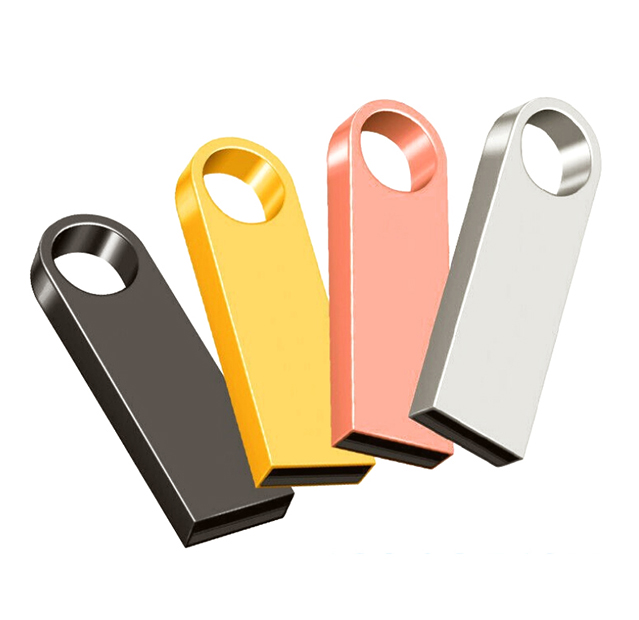
USB Flash Drive
Specification:
*.USB 2.0/3.0 Hot Plug & Play Compatible
*. Available Capacity: 1GB, 2GB, 4GB, 8GB, 16GB, 32GB, 64GB, 128GB, 256GB;
*. Interface: USB 2.0/3.0;
*. Transfer Rate: High Speed USB 2.0/3.0;
*. Data transfer speed: USB 2.0:15MB/s-21MB/s for read, 5MB/s-8MB/s for write; USB 3.0:80MB/s-100MB/s for read, 10MB/s-30MB/s for write;
*. Compatibility: PC or Mac with a USB interface;
* Operating Systems: Windows Vista/XP/2000/ME/98/95 and Mac OS 8.6 and above;
Other optional functions:
1.Password protection function,
2.Auto-run function,
3.Bootable function,
4.Readyboost function
5.Data protection function available
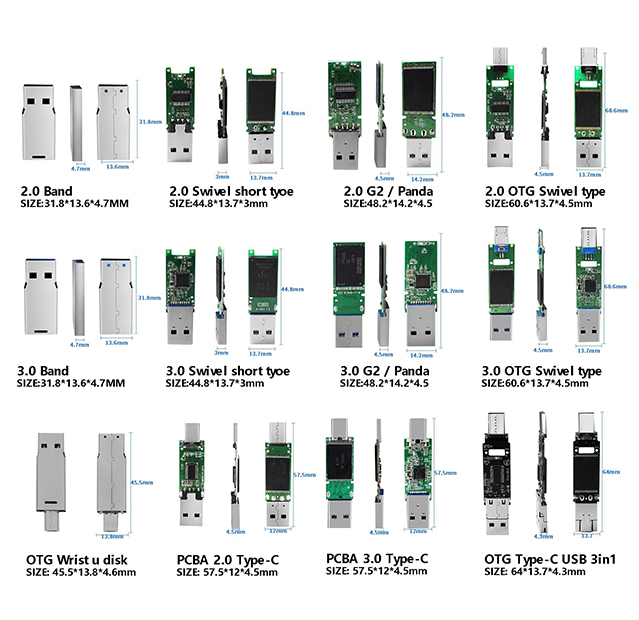
Memory Chips
What is memory chips:
A new production method for USB flash drive
Flash chip is assembled on board together with controller, solution and accordingly software tackling.
The assembled board can be used for whole USB flash drive function, also can be put in almost all USB flash drive cases.
Based on this production procedure, the defect ratio is pretty few and the quality is more stable than regular SMT production.
Advantage of DIY your USB using memory chips:
Super thin and small size. Easier to import. Save the shipping cost.
Better water-proof and shock resistance function, stable quality.
Easy and fast to assemble.
Flexible for production line setup.
Electromagnetic wave protection.
Other optional functions:
1.Password protection function
2.Auto-run function
3.Bootable function
4.Readyboost function
5.Data protection function available
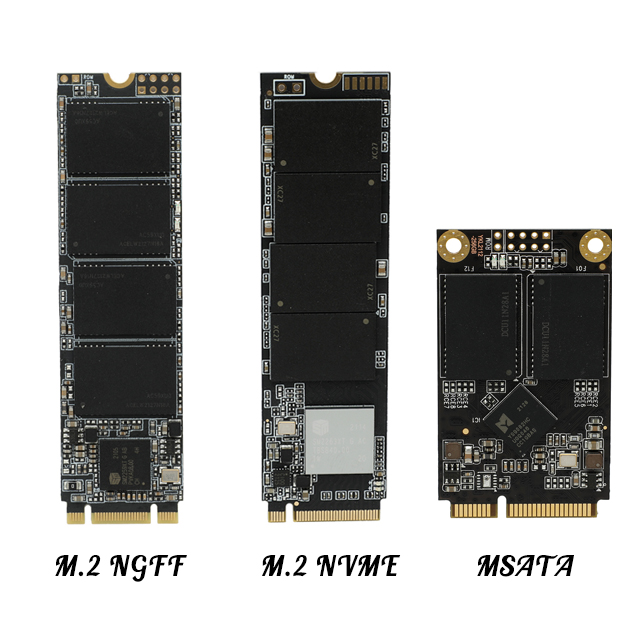
M.2 NGFF/M.2 NVME/MSATA
M. 2 interface is a new interface specification introduced by Intel to replace msata. It can be compatible with a variety of communication protocols, such as SATA, PCIe, USB, HSIC, UART, SMBus, etc.
M. 2 interface also has two different specifications, namely "socket2" (B key) and "socket3" (M key). They all seem to be m.2 interfaces, but they support different protocols and have different effects on speed. At present, m.2 interface supports two channel buses, one is SATA bus and the other is PCI-E bus. Of course, due to the limitation of theoretical bandwidth, the limit transmission speed of SATA channel can only reach 600MB/s, but PCI-E channel is different. The theoretical hard disk interface speed is as high as 32GB/s.
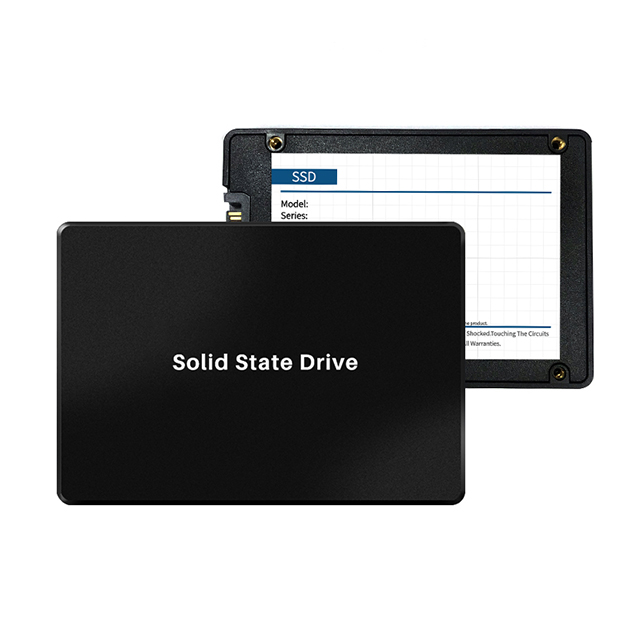
Solid State Drive
About SSD performance test:
1.Difference between SATA I, SATA II and SATA III
SATA I (revision 1.x) interface, formally known as SATA 1.5Gb/s , is the first generation SATA interface running at 1.5 Gb/s. Max speed 150MB/s.
SATA II (revision 2.x) interface, formally known as SATA 3Gb/s, is a second generation SATA interface running at 3.0 Gb/s. Max speed 300MB/s.
SATA III (revision 3.x) interface, formally known as SATA 6Gb/s, is a third generation SATA interface running at 6.0Gb/s. Max speed 600MB/s. This interface is backwards compatible with SATA 3 Gb/s interface.
If SATA 3.0 SSD tested speed on sata2.0 interface and SATA cable, then the result will be inaccurate.
2. Due to different platform or software, the result will be a little difference(we usually use Crystal Disk and AS SSD Benchmark test Our SSD)
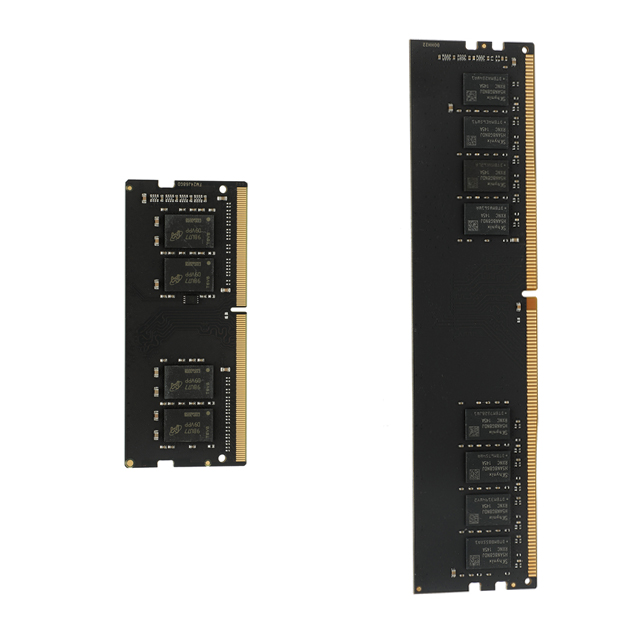
Memory Module
DDR3 provides higher operating efficiency and lower voltage than DDR2 SDRAM. Compared with the previous generation, the core voltage is reduced to 1.5V, and the prefetching is changed from 4-bit to 8-bit. This is also the key to improve the bandwidth of DDR3. In addition, DDR3 also adds CWD, reset, ZQ, STR, RASR and other technologies.
DDR4 16bit prefetching mechanism (DDR3 is 8bit), and the working voltage drops to 1.2V, which is more energy-saving.
The number of DDR4 memory pins has increased from 240 to 288. The golden fingers of DDR4 are high in the middle and low on both sides, with slight curves. DDR4 can not only maintain sufficient signal contact area with DIMM socket, but also remove memory more easily than DDR3. DDR4 theoretically, each DIMM module can reach a capacity of 512gib. The number of bank units in a rank unit increases to 16, and each DIMM module has up to 8 rank units.
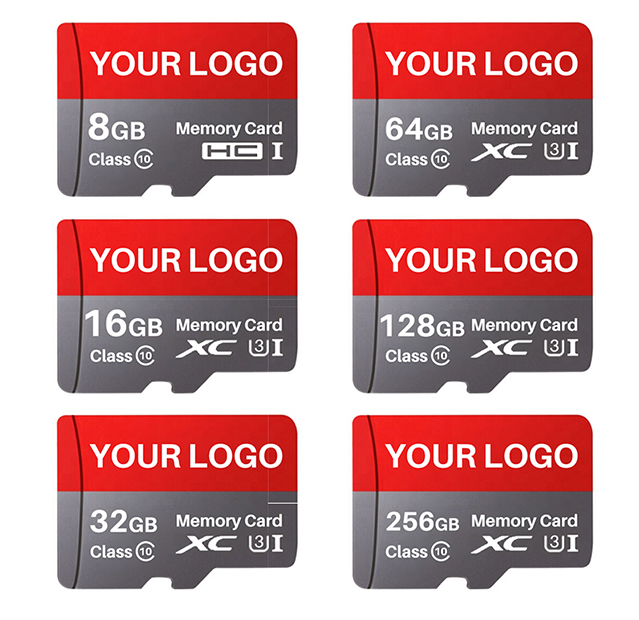
Memory Card
Memory card or flash memory card, flash card, is a solid-state electronic flash memory data storage device, mostly in the form of card or square. It generally uses flash memory chip as storage medium. It is mainly used for digital cameras, PDAs and laptops, music players, handheld game consoles and other electronic devices. It can provide a storage form that can be read and written repeatedly without external power supply. There are also non solid state memory cards.
Memory card UHS speed class:
1.U1—10MB/s, use for 4k2k video recording.
2.U3—30MB/s. use for full HD video recording, continuous shooting of HD still images.
Speed class:
1.Class 2—2MB/s, use for general video recording.
2.Class 4—4MB/s, use for HD or full HD video recording.
3.Class 6—6MB/s, use for HD or full HD video recording.
4.Class 10—10MB/s, use for full HD video recording, continuous shooting of HD still images.
Send Message